
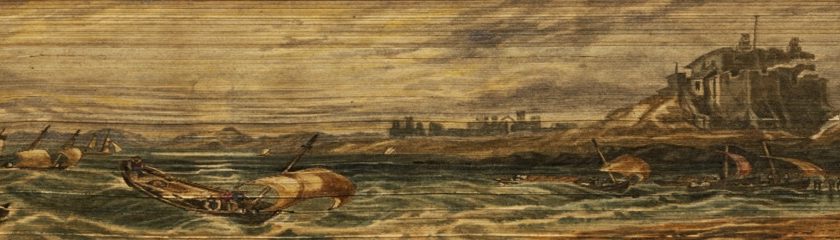
Fore-edge painting of Lindesfarne Abbey

Tools and methods workshops Citation Management with Zotero Monday, September 14, 1:00–2:00 p.m., Digital Humanities Lab and online (Instructor: Francesca Giannetti) REGISTER Thursday, September 17, 1:00–2:00 p.m., Digital Humanities Lab and online (Instructor: Francesca Giannetti) REGISTER Materials and video: https://libguides.rutgers.edu/zotero/tutorials Get started early with keeping track of what you read! Zotero is a free application that collects, manages, and formats citations and bibliographies. In this introductory, hands-on workshop, we’ll learn how to organize sources, attach PDFs and notes, create tags for easy searching, and generate bibliographies. Bring your personal laptop, download Zotero 10.0 for your OS, and the Zotero Connector for your favorite browser. IntroductionRead More →


collage of data viz in textiles

Download CFP as a PDF. Download printable flyer. Are you hungry for a year of Ludd to put a lid on your scroll?1 Do you want to make enchanted things or just plain practical things?2 Feel like pressing pause on being a cloud serf with your attention and your data?3 Are you crafty, maybe even a craftivist?4 Join the Critical Making Community of Practice! The Libraries and the Digital Humanities Initiative are launching a call for participation for a Critical Making Community of Practice in which participants hold informal gatherings this academic year that include presentations and demonstrations that encourage reflection on technology, society, andRead More →

by Caterina Agostini and Francesca Giannetti Introduction Earlier this year, Rutgers was invited to become a participant in the beta evaluation of ITHAKA JSTOR’s Constellate, a text analysis and pedagogy platform. As a result, we have had early view into a rapidly evolving service that aims to advance text analytics pedagogy. While pedagogy is its main thrust at the moment, Constellate is a fairly complex offering that is structured around three “pillars”: data, pedagogy, and research. For readers who are familiar with JSTOR’s Data for Research (DfR) program, which has provided researchers with bibliographic metadata, unigrams, bigrams, and trigrams for JSTOR journals and books sinceRead More →